go beyond remembering

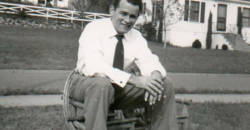
Fourteen years ago today, this young man died a horrible death. You and I–we didn’t know it was happening, we couldn’t help him, but I think we can help others like him. We must, I believe.
Shortly after midnight on October 7, 1998, east of Laramie, Wyoming, 21-year-old Matthew Shepard was robbed, pistol whipped, tied to a fence in a remote, rural area in freezing temperatures, and left to die by two men–Aaron McKinney and Russell Henderson–because he was gay. Shepard was discovered by a cyclist eighteen hours later, still alive but unconscious. The cyclist first mistook him for a scarecrow.
He had suffered a fracture from the back of his head to the front of his right ear. He had severe brain stem damage, which affected his body’s ability to regulate heart rate, body temperature, and other vital signs. There were also about a dozen lacerations around his head, face and neck. His injuries were deemed too severe for doctors to operate. Shepard never regained consciousness and remained on full life support. He was pronounced dead at 12:53 a.m. on October 12, 1998, fourteen years ago today.
There is no reason this beautiful young man should be dead. He should be 36 years old, working in the world at something he cares about, in love, calling his mother on Sundays to say hi, learning how to sail, writing bad poetry, watching reruns, and planning his next vacation. He should be above ground, not below it. And no one should die like that—no one. For a country founded on human rights, we don’t seem to allow for the humanity of others too well, do we? What is it that keeps us in fear and ignorance, instead of curiosity and wisdom? Have we excluded whole groups of people from those human rights? Are ours selective human rights, extended to people in whom we can see ourselves?
It is an awful anniversary, as is June 7 (1998), the anniversary of 49-year-old James Byrd, Jr.’s horrendous killing, a black man beaten, chained by his neck to the back of a pickup truck, and dragged for miles, surviving through most of the experience until his head and right arm were finally severed when his body hit a culvert. Forensic evidence suggests that Byrd had been attempting to keep his head up. In such a world where that is possible, we have not come as far as we would like to believe; no, no, not nearly far enough. I realize this is hard reading. But knowing trumps avoidance. Looking at trumps looking away. The men who killed him dumped his mutilated remains in the town’s segregated black cemetery, and then went to a barbecue.
James Byrd and Matthew Shepard were attacked on June 7, 1998, and October 7, 1998. It is still happening today, every day. That people kill one another over skin color and sexual orientation shakes me to my core. And yet, being shaken doesn’t do a thing to stop it from happening again. I sometimes feel like I don’t belong and can’t live in a world in which people can hate people for who they are, or sometimes–as in the killings of random people who looked Middle Eastern after 9/11–for who we believe they are. And yet, though the loss of James Byrd and Matthew Shepard is horrible beyond words, I can’t help believing that the kind of hate that is more dangerous is not the kind that leaves a young man hanging on a fence, but the more insidious, hidden kind that lives right along beside him year after year after year, telling gay jokes or laughing at the ones told by co-workers, making snide remarks about how gay something is, disparaging the photographs of gay partners in the newspaper.
In the same way, this fight won’t be won by larger-than-life crusaders, but by single individuals who speak up in management meetings when someone tells a racist joke, by mothers who buy diversity friendly books for their toddlers, by people like Esther who respond to stereotypical statements with “I don’t see the truth in that,” by straight teenagers who join Gay/Straight Alliances at their high schools, by joining a book club to read books that challenge and enlarge our view of reality.
I am not sure that I can embrace the kind of ignorance and fear that would lead people to do these things, but I can learn from it. And as someone who espouses to value diversity—isn’t it those people I should walk straight toward? I don’t honor Matthew Shepard’s memory by merely calling them ignorant, after all; I honor his memory by walking toward them, learning from them, trying to teach them.
It occurs to me as I write this that we are racist even in our hierarchies of national awareness, I fear. James Byrd’s name doesn’t ring many bells when I talk about him in speeches, but Matthew Shepard’s does. Why is that? Young women of color go missing in great numbers each year, yet our national attention is riveted on wealthy, white women: Elizabeth Smart the harpist, Chandra Levy the Capitol Hill intern, Jennifer Wilbanks the runaway bride. Why don’t we know the names of Tamika Huston, Tyesha Bell, or Alexis Patterson? They are missing like their white counterparts, but their names and stories are unknown. Why?
The leading cause of death for pregnant women in the U.S.is murder, disproportionately high for mothers of color, yet People magazine focuses on Laci Peterson and Lori Hacking and not their dark-skinned compatriots like Evelyn Hernandez, her pregnant torso also found in the San Francisco Bay.
Is it less important, less newsworthy, less relevant to lose people of color? Are minority victims, in effect, less human? Is their sorrow not as sorrowful, their tragedy not as tragic? Is it that we can’t see ourselves in them, in their stories, that their missing doesn’t strike to our own vulnerability because we are Not Like Them?
This is not to suggest that we invest in measuring the impact of whose death is more important—it is impossible to do so—it cannot and should not be done. But it is something to notice, something to hold our media accountable to. To play the Oppression Olympics is to dishonor Matthew Shepard, James Byrd, Evelyn Hernandez, Tamika Houston, and yet the disparity of acknowledgment troubles me.
We need to take action, stand up, step out, get uncomfortable. Hate crimes won’t end until those of us who are not hated are as outraged as those who are.
Matthew Shepard was someone’s baby, toddler, child, young adult child, now dead. Find a way to honor his memory today. Send his mom, Judy, an email to tell her that you remember on this awful anniversary.